

Department of
Nutritional Science
Foster registered dietitians to support healthy lives of people

Opportunities for registered dietitians to exercise their skills to build a healthy society are continuously expanding. They are needed in a variety of fields, including not only medical care and social welfare but also companies that provide food and meals. This department fosters communication skills, the ability to ameliorate problems on your own, and decision-making judgement to cultivate registered dietitians who will be food professionals and work-ready.
-
Increasing food- and health-related needs in super-aging societies
Maintenance and promotion of health and prevention of lifestyle diseases, frailty, and dementia. Diet is deeply involved in this. Protection of health before getting sick. This is also highly expected of registered dietitians. -
Deepening the spirit of team-based care through collaboration with other medical faculties
The presence of other medical faculties, such as the School of Dentistry and School of Pharmacy, is a distinctive feature of Aichi Gakuin University. Students can acquire high-level knowledge and skills suitable for a member of team-based care. -
Diverse learning about food expands your options for the future
Graduates are active in a wide range of industries from hospitals to food manufacturers. Our wealth of practical learning, including recipe development and food promotion, allows you to demonstrate your skills in a variety of business fields.
Improve your expertise with deep and extensive learning to cultivate knowledge needed for team-based care
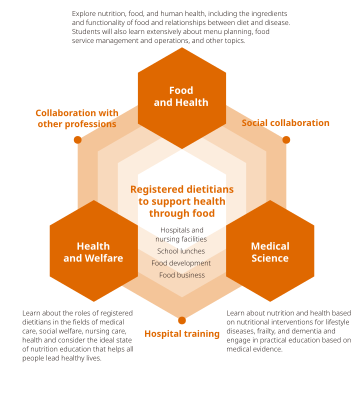
The program emphasizes medical studies, allowing for comprehensive learning about Food and Health, Medical Science, and Health and Welfare. We provide registered dietitian education that enables you to play an active role as a member of team-based care. Our aim is to train professionals in health and nutrition. Students engage with nutrition therapy and nutrition education that is useful in clinical practice through lectures given by faculty members with a variety of medical qualifications and practice at an affiliated hospital of the School of Dentistry.
Four-year curriculum for becoming a nationally qualified registered dietitian
Toward preparation for the national exam
-
1st year
Learn natural science, humanities, and social science
Acquire basic knowledge of nutrition, food, and health
Increase awareness of food-related issues
Common lectures with other medical faculties and career guidance from graduates
Develop a broad social perspective
-
2nd year
Cultivate practical skills through numerous experiments and exercises
Deepen expertise in nutrition, food, and health
Overseas training for registered dietitians (optional)
Task-based learning in groups across medical faculties, including other universities (pharmacy, nursing, dental hygiene)
Learn about team-based care from a variety of angles
-
3rd year
Prepare food at large scale in food service management practice
Learn about nutritional therapy and guidance
Experience actual work in off-campus and clinical practice
Make a career plan for after graduation
-
4th year
Specialized learning and research in seminars
Joint ultra-large-scale interprofessional education with four medical universities
Give guidance to patients at affiliated hospital (elective subject)
Become a registered dietitian who contributes to a healthy society
Prepare for national exam
Obtain dietitian license upon graduation (all specialized subjects required for the license are compulsory for graduation)
-
TOP
-
Academics
-
Faculty of Health Science
-
Department of Nutritional Science