

Department of History
Deeply explore world history to develop the ability to decipher
the present times

History is full of fascinating episodes, as depicted in movies and games. But history is comprised of intricately intertwined threads. Events around the world influence each other. Deciphering history in depth helps you understand the origins of the modern world and acts as a guidepost for your future.
-
View the history you think you know from a bird's-eye view
Historical Studies is not just about tracing the past of each country. With a broad and free perspective like a bird in flight, it unravels history from a variety of angles that cannot be captured by a timeline alone. -
System of five specialized courses, including Islamic History, found in no other history department
The department's philosophy is that historical studies are not complete in a single course. For that reason, students can learn flexibly, meaning, for example, that Japanese history course students can also learn about Islamic culture. -
Fieldwork such as excavation surveys to trace the footsteps of humanity is fun
A variety of fieldwork, such as visits to historical sites and shrines in Japan and abroad as well as field and excavation surveys, is conducted in classes and seminars. By tracing the footsteps of history, the knowledge acquired in the classroom is transformed into something deeper.
Five specialized courses of study that extensively explore history
This is one of the few departments in Japan where students can learn extensively about the course of every region and era around the world, including Japanese History, Oriental History, Western History, History of the Islamic World, and Archaeology. After learning an overview of the five fields in Year 1, students select specialized courses of study, from Year 2 onward to deepen the expertise in each field and produce a unique graduation thesis.
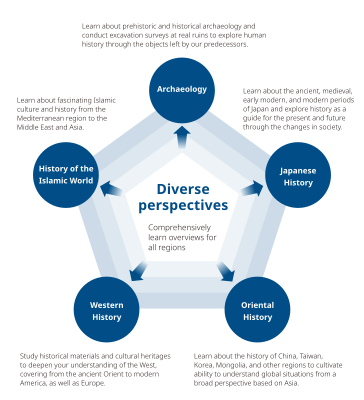
Four-year curriculum for acquiring diverse perspectives
Pursue your interests
-
1st year
Extensively learn overviews of the five fields
Acquire diverse perspectives
Guidance sessions are held for course and seminar selection; students select their course of study at the end of the school year
-
2nd year
Students select from five courses of study; learning in seminars starts
Acquire basic reading comprehension, interpretation, and summarization skills for the content of historical materials and literature
-
3rd year
Deepen expertise in seminars
Determine a research theme for the graduation thesis
Develop skills to read more specialized historical materials and literature as well as presentation skills
-
4th year
Proceed with the study while discussing in seminars
Complete the graduation thesis
Improve thinking ability, analytical ability, and presentation skills applicable to the professional world
-
TOP
-
Academics
-
Faculty of Letters
-
Department of History