

Department of
Pharmaceutical Health
Care and Sciences
Foster pharmacists who contribute to community health care with
the latest pharmacy knowledge

In recent years, the role of pharmacists in community health care has been increasingly valued. The curriculum of this department combines a good balance of the basic pharmacy knowledge of a researcher, medical skills of a pharmacist, and humanity of a healthcare professional, as well as interdisciplinary lectures and other activities implemented to raise awareness about team-based care. We work with the community to foster pharmacists who can support healthy living.
-
One of the highest national exam pass rates in Japan, backed by substantial study support and know-how
We have a learning support system in which two faculty members act as advisors immediately after students enroll. This deepens student understanding gradually from the basic, leading to them passing the national exam. -
What can a pharmacist do? Team-based care you can only experience at AGU
In interdisciplinary lectures undertaken together with other faculties, students can experience team-based care, which is important in modern medical care. This enables them to reaffirm the role of pharmacists in medical settings and absorb perspectives and knowledge from other medical professionals. -
Substantial support to expand your future possibilities, from hospital to pharmaceutical company and government employees
The School of Pharmacy has extensive job-seeking support. After graduation, you can work as a hospital or pharmacy pharmacist or as a medical information or public health specialist in a variety of professions.
Extra advantages that open the way to the future of medical care
Become a pharmacist with strong data, research, and community health care skills
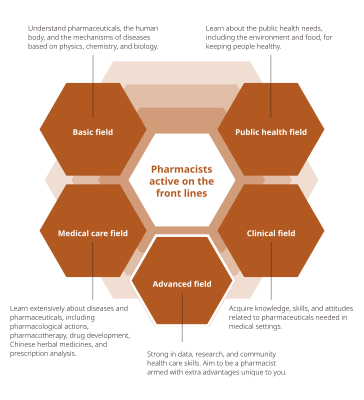
Through our extensive curriculum covering basic, public health, medical care, and clinical fields, students acquire advanced expertise regarding diseases, pharmaceuticals, and pharmacotherapy and cultivate practical skills required in medical settings. Students participate in joint lectures with other medical faculties and health support volunteer activities in the community to become healthcare professionals who are strong contributors to society. We also cultivate pharmacists armed with extra advantages unique to them to contribute to community health care development by improving data utilization skills and developing proposal-making skills for new medical care based on the results of research.
Six-year curriculum for becoming a nationally qualified pharmacist
For passing the national exam
-
1st year
Decide learning roadmap at new student orientation
Introduction about chemistry, biology, physics, and pharmacy, as well as medical ethics
Double support system
Consistent support for six years
-
2nd year
Deepen understanding of the human body and diseases
Learn about the properties and mechanisms of action of pharmaceuticals
Visit medical settings in early experiential learning
-
3rd year
Understand appropriate usage of pharmaceuticals
Learn about drug interactions and side effects
Learn extensively about disease treatment
-
4th year
Practice based on the actual work of pharmacists
Decide a field to deepen and join a lecture for graduation research
Check basic skills through the Pharmaceutical Common Achievement Test
Cultivate comprehensive skills in Pharmacy Comprehensive Learning I and objectively check skills in CBT mock exams
-
5th year
Deeply understand pharmaceutical expertise
Learn about team-based and community health care
Clinical practice at off-campus hospitals and pharmacies
-
6th year
Acquire the knowledge and skills for new drug development
Present graduation research results on campus
Deepen understanding by integrating your six years of learning in Pharmacy Comprehensive Learning II to pass the national exam
-
TOP
-
Academics
-
School of Pharmacy
-
Department of Pharmaceutical Health Care and Sciences