

Department of
Economics
Explore the essence of the economy to foster next-gen professionals

Transformation has been accelerating in the economy since the COVID-19 pandemic. This department provides a wide range of ICT-related subjects, from learning about methods of collecting business data to analyzing the global economy. We also offer substantial English education for business. We foster individuals who will lead next-gen business and can contribute to solving economic problems.
-
Keys to an economy with accelerating transformation: digital skills and English
Since the COVID-19 pandemic, the world economy and business have changed rapidly. To respond to these changes, we offer a curriculum with two pillars: digital skills and English. -
Global perspective and ability to act locally essential for business
By cultivating perspectives for deciphering global economic trends from multiple angles and the analytical and proposal-making skills needed to promote regional economies, we produce "glocal" individuals connected to both the world and the local community. -
Learn from faculty members with rich business experience at the heart of the economy in the Chubu region
We have many full-time faculty members with rich business experience in banking and other areas. Acquire the ability to solve economic issues by learning the perspectives of economic professionals active on the front lines.
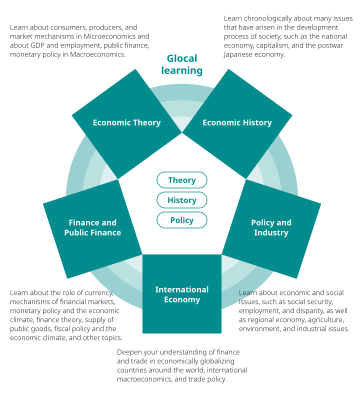
Five specialties of economics to learn from theory, history, and policy perspectives
Economics is a discipline that helps solve issues in contemporary society. To deepen knowledge and understand economic society correctly, we approach economics from three angles: theory, history, and policy. We zero in on the essence of economic events occurring in the Chubu region, Japan, and the world currently to foster members of society who are knowledgeable about economic policy.
Four-year curriculum for analyzing global economic trends
Glocal thinking skills
-
1st year
Learn the basic theory of economics
Build a foundation for English, mathematics, and information
Acquire a wide range of knowledge about society
*No division into courses of study
-
2nd year
Examine economy from theory, history, and policy perspectives
Explore a study theme derived from economic events
Learn according to five study models
Start learning in seminars from the fall semester
-
3rd year
Solve issues through economic analyses
Decipher real-world economic trends
Study economic events with peers in seminars
Systematic learning for the future
-
4th year
Studies utilizing knowledge of economics
Cultivate ethical judgement and lifelong learning skills
Complete graduation thesis in fall semester
Substantial faculty-specific career education
-
TOP
-
Academics
-
Faculty of Economics
-
Department of Economics